Convert, Reclaim, Recover

welcome

This blog was created to support and promote the ideas of recycling and saving Mother Earth, by any means necessary. This blog has been written to target individuals who care about earth and would like to discover ways to help save the earth and all beings on it. Budding environmentalists are welcome here. I will primarily be speaking/complaining about the lack of recycling bins/care for the environment in New England. Mostly, I'll speak about Rhode Island, and URI. I hope all that read this blog will also pass on this information to others who may be interested. I will be posting about ways that we are harming the earth, and then giving ideas on how to help save the earth. I will also focus on recycling, it's benefits, and the types of items that can be recycled. If you care about the earth, or are looking for some tips on recycling, you've come to the right blog.

Harvesting Solar Heat from Roads


An article on some very cool information. Researches here at the University of Rhode Island have discovered ways to harvest solar energy from asphalt, which, if proves to be a success, could mean another type of reusable energy that we can use to save the earth.

“We have mile after mile of asphalt pavement around the country, and in the summer it absorbs a great deal of heat, warming the roads up to 140 degrees or more,” said Prof. K. Wayne Lee, leader of the URI project. “If we can harvest that heat, we can use it for our daily use, save on fossil fuels, and reduce global warming.”

If anyone would like to check out the website of Rhode Island's Resource Recover Center; here it is.

URI - Recycling around Campus.


As one walks around campus, you'll probably notice the garbage cans. How could you not? They're practically everywhere. In fact, just around the quad, there are about 4 or 5 garbage cans. But wait, where are the recycling bins?
URI seems to think that people will only be recycling inside the memorial union, and right outside the "ghetto" dorms.
There are no recycling bins anywhere around campus. Atleast, none that I have found.
So, URI, if I'm walking to class drinking an Arizona Tea, where am I supposed to put the can? In a garbage can, you say?
Then why, does the URI website have a separate section for Green Links(!!), if we do not even have a bin or box in which we can place our recyclables in, during our walks to and from class.
And apparently, only students who live in dorms around Gorham and Hopkins need to be able to recycle, as I have not seen any recycling bins around Wiley, Garrahy, Burnside, or any other dorms.
I'm considering sending URI a letter of complaint.

For all those interested in seeing URI's "Green Links", click here.

H.I.P.P.O.


Habitat Destruction
Invasive Species
Population Explosion
Pollution
Overconsumption

In my girlfriend's Entomology class, she learned about H.I.P.P.O, which stands for the above. HIPPO is an acronym for things that are occurring that are not only destroying species of animals, and plants, but also the earth.
Habitat destruction affects the creatures on this earth, and ultimately, humans. If we continue to cut down trees and dig for fossil fuels, we continue to destroy habitats of animals. The animals whose habitats we have destroyed usually come into OUR habitat. An example of this would be Coyotes, who have been run out of their habitats, and into ours, and have begun eating pets and attacking children.
Invasive Species, such as the Asian Longhorn Beetle, are species that are not native to the area, but once they have arrived there, they basically take over. They have no enemies, and will continue to consume and consume until they have completely destroyed another creature's habitat. The Asian Longhorn Beetle arrived in America from China during transport of bananas. These creatures are now all along the east coast, destroying our trees.
Population Explosion is what humanity does best, create more and more children until we run out of room. Due to our explosion of population, we are using more and more resources.
Pollution is self-explanatory. We are harming and polluting the earth with our constant use of resources, and items that cannot be biodegradable.
Overconsumption is the last letter, and basically once again refers to humanity's constant over consumption of everything. We eat too much food, and use too many fossil fuels.

A video of Edward Wilson's speech on HIPPO:

The Recycling Episode of The Magic School Bus!


A Recycling Table, to make things simpler.


Is the Kindle green?


One question that I got was, if the Kindle truly is green.
The answer is basically, yes, if you use it often enough.
The journal of Environmental Science and Technology has estimated that by replacing your daily newspaper or magazine to the e-version, you will be saving approximately one tree per year.
Trees , of course, are not the only things being saved, but energy, chemicals, and fossil fuels as well. A study found that 67 times more water is consumed and 140 times more use of CO2 (carbon dioxide, a greenhouse gas), is emitted by printed newspaper, versus the electronic one.


An 11 year old environmentalist?
My heart is happy. :)

URI apartments and recycling


Something that has been bothering me more and more lately, is that there are literally no recycling bins anywhere near my apartments.
I live in the University Apartments, at the top of campus. There are four buildings, with an average of 12 people living in each building. Around 48 people live in my area of campus, which, as you can guess, means a LOT of garbage. According to one study, each American produces around 5.1lbs of garbage a day. In one day, my apartment buildings produces about 240lbs of garbage a day.
Personally, I know that nearly a third of the garbage that is thrown away in my apartment are recyclables; cans, bottles, paper, etc. However, there is literally no recycling bins near my apartments. In fact, the closest recycling bins are in the Memorial Union.
Why would URI, knowing that college students living together would amass intense amounts of garbage, not place recycling bins anywhere near the vicinity of the apartment buildings that I live in?!
It's absurd, that we are forced to throw our recyclables into the trash, forcing us to pollute the planet.

Simple tips for Saving the Planet - and also, save yourself


  1. Drive Less
    -Walk, ride a bicycle, skateboard, Rollerblade, or even take public transportation. Doing any of these things will improve your health by forcing you to exercise.
    -If you drive less and leave the car at home, you not only reduce air pollution, but you also lower greenhouse gas emissions, save money, and improve your health.
    -Research has shown that families who use public transportation save enough money annually to cover their food costs for a year.
  2. Eat more Fruits, Grains, and Vegetables
    -Raising animals to be used for consumption produce more greenhouse gas emissions than growing plants.
    -A report by the University of Chicago found that adopting a vegan diet does more to reduce global warming than switching to a hybrid car.
  3. Use Reusable shopping bags
    -Worldwide, up to a trillion plastic bags are used and discarded every year.
    -Reusable shopping bags reduce pollution and save natural resources that would have been used to make plastic or paper bags.
  4. Use fluorescent or LED light-bulbs.
    -They are more energy efficient, and less expensive.
    -According to the Union of Concerned Scientists, if every U.S. household just one regular light-bulb with a fluorescent light-bulb, it would prevent 90 billion pounds of greenhouse gas emissions from power-plants.


"According to the Environmental Protection Agency, the average American produces about 4.4 pounds (2 kg) of garbage a day, or a total of 29 pounds (13 kg) per week and 1,600 pounds (726 kg) a year. This only takes into consideration the average household member and does not count industrial waste or commercial trash. If this sounds like a staggering number, you would be surprised to know that Americans are not the number one producers of garbage in the world. In Mexico, the average household produces 30 percent more garbage than in America."

-Source

What Should I Recycle?


Things that should be added to Recycling bins and kept out of landfills:

Batteries, Cell Phones, Computers, car batteries, motor oil, paint, etc. This type of waste is a big deal. It definitely needs to be recycled because they are highly toxic, and if they are put into landfills, can cause big damage.
Paper, plastic, glass, aluminum, steel, and copper.
Paper means all paper items, such as phone books, magazines, paper towel rolls, cardboard boxes, etc.
One thing that you need to know is that you need to keep your paper products separate from everything else, such as peanut butter jars, because paper products cannot be recycled when they’ve come into contact with moisture, which is why pizza boxes are not allowed to be recycled.
Deodorant and chapstic containers can also be recycled as well, placing them alongside the plastic.
Any canned items can be added to your recycle bin.

Why Should I Care?


When someone brings up the idea of recycling or saving the planet, a great many people react with "Why Should I Care?" or "Why Should I Recycle?"
The benefits of recycling can have a tremendous effect on our planet. "Well why should I care about the planet? I'm not going to be here long."
That is a terrible way of looking at things. We need to preserve and keep the earth healthy and beautiful for our children, for our children's children, for all future generations of human and animals.
The Environmental Protection Agency reports the United States produces approximately 220 million tons of garbage each year. Considering the United States is about 4% of the worlds population, one can estimate the entire planet's yearly production of garbage to be around 5 billion tons.
Imagine a world where nobody recycled. 5 billion tons of garbage a year, laying around in our rain-forests, our towns or cities, landfills reaching their capacity and pouring onto the streets. Our earth would be ruined.
Every little bit of recycling counts. Every effort makes a dent, even if you are just making sure to recycle paper every morning, you are keeping something that can be recycled out of the landfill, and making sure it gets reused.

"Recycling takes up too much of my time. It's far too time consuming."
Many people feel this way, however, it is not true. You need to focus on adding recycling as a daily part of your day, until you don't even realize that you're putting any extra effort into keeping the world a better place.

"Will Recycling cost me anything?"
It depends on how far you want to go to help. If you just plan on recycling at home, it will usually not need to cost you any money. It may cost you time however, because you usually need to wash, dry, and set aside the items you wish to recycle, but like I said, if you just focus on putting this as part of your daily routine, it will not feel like you've wasted any time of your day at all. It also helps to know that you are saving the planet just by spending an extra hour or so a day.


"Why should I do something now about recycling?
Because the biggest most powerful changes lie in the habits and attitudes of ordinary people. Becoming environmentally aware and responsible is no longer an option for the few. If we want to save our world from an environmental catastrophe we must all act now and together. This is the only way to send a clear message to politicians and decision makers that we need change"

Michael Pritchard's water filter turns filthy water drinkable


The Big E and Recycling


Recently, I attended the Big E. The Big E is The Eastern States Exposition, which is a large fair in Massachusetts. It is the sixth largest agricultural fair in the county, and the largest in New England. This fair draws large crowds, people from all over the country, who want to walk the 175 acre fair, eat the food, and participate in any of the other types of entertainment. Due to the immense amount of people (nearly one million people!), you can just imagine how much littering, pollution from smoke, and other types of environmentally harming behavior that occurs at this one event.
In previous years, The Big E did not have any means of recycling the many cans and containers for food. There were just large trash cans placed everywhere.
However, this year, The Big E has tried to become a little more green and more friendly, placing recycling bins at certain areas, along with the garbage cans, giving a people a chance to recycle if they wish.
They have a bit of work to do, because there are still issues in the bathrooms and in restaurants.

Six Easy Ways to Save Water


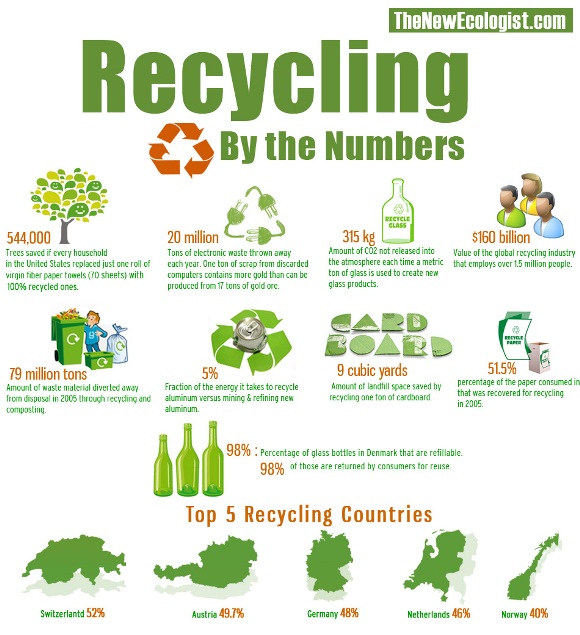
Here is this image I found from www.TheNewEcologist.com. It really shows the true impact of Recycling.

5 Easy Ways To Save The Planet - a video


Did You Know?


Smoking Tobacco and Cigarettes aids in the destruction of trees?
According to both www.ucanbreathe.com and www.tobaccoleaf.org, since the late 1800's, far before humanity became concerned with the environment, the tobacco industry has been reported to use at least 1% of all trees.
Nearly 12.5 million acres of forest are destroyed each year to provide trees to cure tobacco. That's about a tree every two weeks for the average smoker.
That means tobacco kills more humans and trees than fires ever would.


You can read more about Tobacco and it's effects on trees, here.

Easy Ways to Help Save the Earth


One website that I hold dear to me, that has excellent advice is http://www.50waystohelp.com/
I first discovered this website when doing research on how to become an environmentalist, and how to help save the earth. I was young and really had no ideas on how to make an impact. Could one person really make an impact? The answer is yes, no matter how small your impact may be, it is still one more step in the correct direction, one more step to saving our Mother Earth.

Some of my favorite pieces of advice that this website gives are;
-Go Vegetarian once a week.
-Use both sides of the paper
-Shower with your partner
and
-Use rechargeable batteries.

Not only are these pieces of advice given, but reasons for them are mentioned as well. The advice is short, and concise. Sure to not lose attention of those who are less inclined to reading.

Welcome!


Hello new readers,
My name is Sabrina, and I'm here to talk to you about saving the planet.
One blog post at a time.

I became concerned about the planet ever since middle school, when Recycle man came to the school and did a presentation. While I was young at the time, I did all I could to enforce recycling in my household. I even forced my younger brothers to start separating bottles and paper from the rest of the garbage.
Now, while I do focus on saving the planet, I also focus on saving money.
A big waster of trees and resources are college campuses.
Think about it, a college this big, with almost no recycle bins. The thousands of bottles, cans, and boxes that get thrown away on a daily basis are taking a toll on this campus.
Also take a moment to think about the amount of paper we waste in classrooms.
Teachers print syllabi, they print outlines for assignments. Students print their homework assignments; lab reports, research papers, speeches.
Paper, and money, is constantly being wasted on this campus.
Take into consideration the price of a printer, cartridges of ink, and printer paper.
The university would be much more eco-friendly if everything moved to Sakai.
Teachers are slowly starting to convert to Sakai, putting up syllabi, putting up assignments. But what about the students?
We waste money, and destroy the planet by printing out 20 page research papers, handing them in, and throwing them out as soon as they are graded.
Instead, the university could allow students to upload their homework via pdf format onto Sakai.
Not only is this option cost-friendly for the students, but it also cuts down on the amount of trees wasted.